At the 2000 annual meeting of the American Bantam
Association, the Butterscotch Calls were formally admitted to the Standard.
The Standard description which appears here has been officially adopted.
Because this description will not appear in the Standard until the next
edition is printed, it is suggested that a copy be downloaded for reference.
- Lou, 01/12/2001
Color- Male
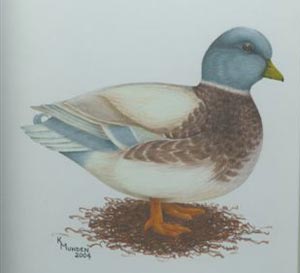
This drawing
of the ideal Butterscotch male shows correct head and neck coloration.
Head: Pastel blue
Eyes: Brown
Bill: Greenish yellow with black bean.
Neck: Pastel blue with a white collar completely encircling the neck.
Back: Claret laced with white at the shoulders; becoming darker blue of a shade similar to that of the head over the rump.
Tail: Creamy buff shaded with pale blue. Sex feather- pale blue.
Wings: Greater and lesser coverts- bluish buff.
Primaries- Creamy buff. Secondaries- pale blue similar to the shade on
the head with creamy buff at the tips forming a light bar. Tertials-
claret tipped or frosted with creamy buff. Wing linings and axillars-
creamy buff
Breast: Claret frosted with creamy white.
Body and stern: Underbody and abdomen- creamy white.
Cream color gradually changing to claret at the breast. Flanks- rich
claret with delicate frosting, cream frequently forming a narrow band
on upper edge of covert just below the wing.
Stern- pale blue of a shade similar to the head.
Legs and toes: Orange
Undercolor: White
Male in eclipse: Closely resembles the female in color.
Common color defects in male: Lack of cream frosting
on breast; black rather than brownish overlay of color in wings; loss
of color at throat and/or upper neck, pure yellow bill.
Color- Female
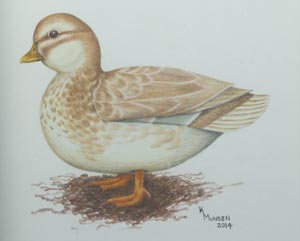
This portrayal
of the ideal Butterscotch Call female displays the double eye streaks which are very important.
Head: Base color is creamy white with butterscotch crown and butterscotch eyestreaks forming a distinct contrast to the cream color.
Bill: Pale yellow shaded with a bluish brown saddle. Bean: often lighter in color than the rest of the bill.
Neck: Cream base color with a butterscotch band extending down back of neck from the crown to the base of the neck.
Breast: Upper breast lightly speckled with butterscotch on a cream base color. Cream lower breast color.
Body and stern: Back- Butterscotch edged with cream
often showing a pale blue streak at the feather shaft. The markings
frequently grow lighter and less distinct as they approach the stern.
Flanks- cream with pale butterscotch speckles.
Tail: Cream shaded with butterscotch.
Wings: Greater and lesser coverts- pale blue
becoming butterscotch, edged with cream. Primaries- Creamy
butterscotch. Secondaries- Creamy butterscotch with cream band at the
tips. Tertials- butterscotch. Speculum- bluish gray Wing linings and
axillars- creamy buff.
Legs and feet: Orange
Undercolor: White
Female in eclipse: Darker in all sections with most markings less distinct.
Common color defects in the female: Indistinct
eyestreaks; base color of back distinctly blue rather than
butterscotch; base color of head and/or neck brown rather than cream;
brown band on back of neck missing or indistinct.
Disqualification: Total lack of the characteristic eyestreaks in the female.